

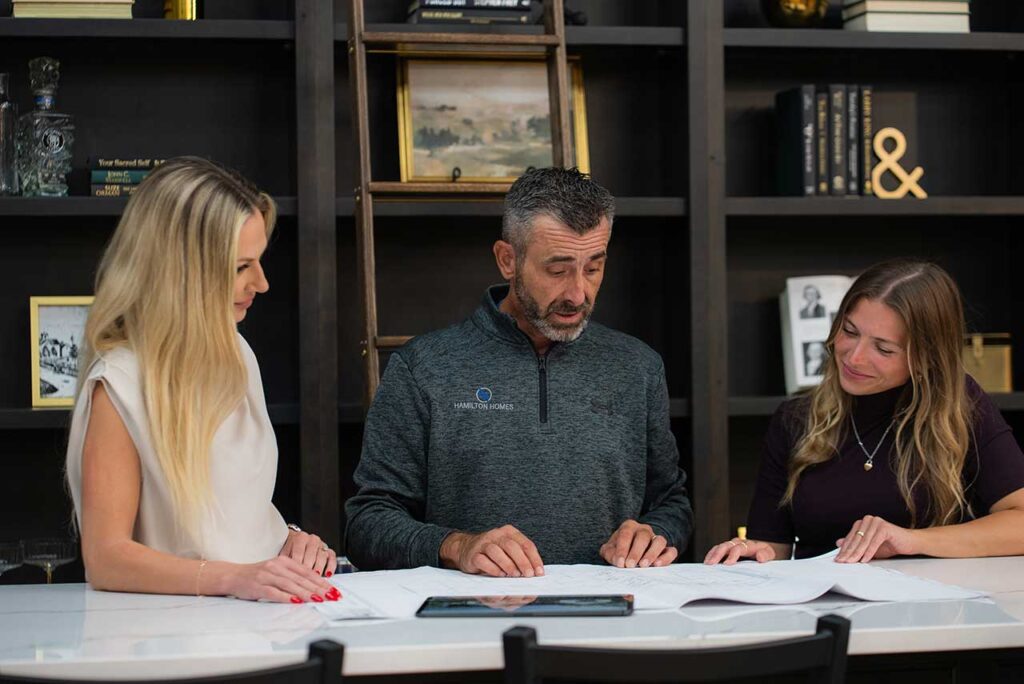
You’ve done the research.
You’ve browsed floor plans. You’ve compared builders. You’ve looked at lot prices and build prices and run the numbers in your head – maybe on a napkin, maybe on a spreadsheet, maybe at 11 p.m. when you couldn’t sleep because you were thinking about that piece of land off M-53.
And the number you landed on felt possible. Tight, maybe. But possible.
Here’s what we need to talk about: that number is probably incomplete.
Not because you did anything wrong. Not because you can’t afford to build. But because the homebuilding industry has a language problem, and it costs families real money.
The Three Numbers Nobody Puts on One Page
When most people think about the cost of building a custom home, they think about one number: the build cost. That’s the price to construct the house itself. The framing, the roof, the drywall, the finishes — the house.
But a custom home doesn’t float in space. It sits on land. And land has a price, too. That’s your lot cost; what you pay to own the ground your home will stand on.
Most families get this far. Build cost plus lot cost. Two numbers. One budget.
What almost nobody talks about — until it’s too late — is the third number.
Site condition costs.
These are the costs required to make your specific piece of land ready to support your specific home. And they vary wildly depending on what’s happening beneath the surface and around the edges of your property.
We’re talking about:
- Soil conditions. What’s under the topsoil? Clay? Sand? Rock? Organic material that can’t support a foundation without engineering? You won’t know until someone drills a hole and looks.
- Water table depth. How high does groundwater sit? This affects your foundation type, your drainage plan, and in some cases whether a basement is even feasible.
- Septic viability. If your lot isn’t connected to municipal sewer, you need a septic system. But not every lot can support one — and the type you need depends on a percolation test that has to be done on that specific parcel.
- Grading and drainage. How flat is the lot? Where does water go when it rains? What has to move before a foundation can be poured?
- Utility access. How far are water, gas, electric, and sewer lines from your build site? Every foot of distance adds cost.
These aren’t upgrades. They aren’t optional line items. They’re the non-negotiable costs of putting this house on this land.
And if nobody investigates them before you commit, you’re budgeting for a home you might not be able to afford, on land whose true cost you don’t yet know.
Why Most Builders Don't Tell You This Upfront
Here’s the uncomfortable truth: most builders estimate site condition costs.
They look at the lot. They look at neighboring builds. They make an educated guess. And they give you a number that feels reasonable because it’s designed to keep the project moving forward.
The problem isn’t that the estimate is always wrong. The problem is that when it is wrong, you’re the one who pays.
A site cost estimate that comes in $30,000 over expectation mid-build isn’t the builder’s problem. It’s yours. The foundation is poured. The framing is up. You can’t walk away. And now you’re choosing between blowing past your budget or cutting finishes you were already excited about.
David Hamilton, who has been building custom homes in southeast Michigan for over 30 years, has a phrase for this:
“I will not come to you and say, ‘You know what? I’m sorry. It was a little bit more than I thought.’ I don’t do that.”
He doesn’t do that because Hamilton Homes doesn’t estimate site conditions. They investigate them.
What Due Diligence Actually Looks Like
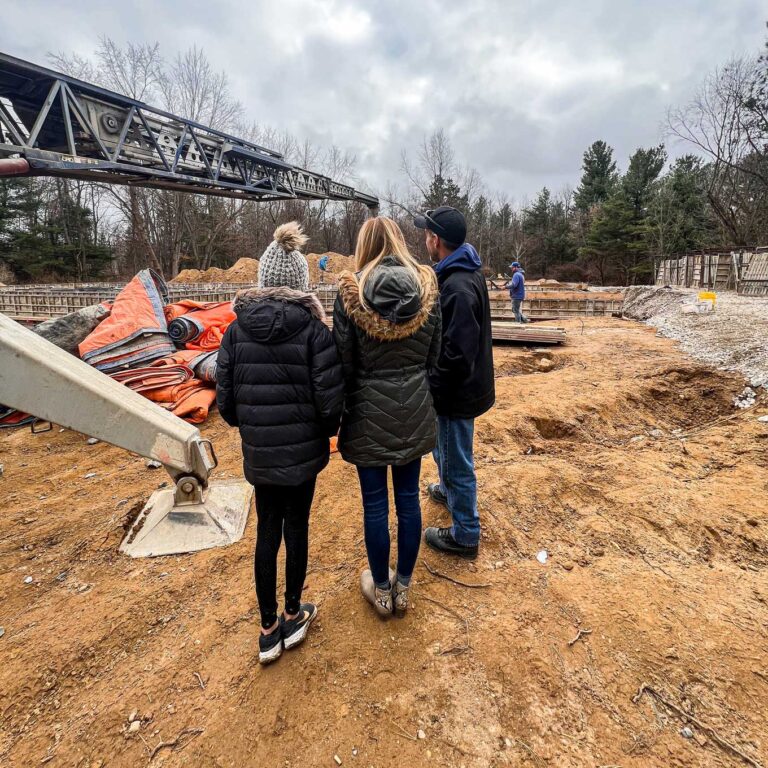
Before Hamilton Homes will let you commit to a build, the team does something most builders skip: they spend 45 to 60 days investigating your land.
That means:
- Soil borings. Drilling into the ground to physically test what’s below the surface. Not guessing from a neighboring lot — testing yours.
- Percolation tests. If septic is required, testing how your soil absorbs water to determine what system is needed and what it will cost.
- Engineering analysis. Having the data reviewed by professionals who can identify foundation requirements, drainage needs, and any structural considerations specific to your parcel.
- Full site condition pricing. Turning all of that data into a guaranteed number; not an estimate, a guarantee that becomes part of your build agreement.
When David says the site condition cost is $42,000, it’s $42,000. If something unexpected drives it to $45,000, Hamilton absorbs it. The number you agreed to is the number you pay.
That’s what a guaranteed site condition cost means. The only person who can raise your price is you — through the selections and upgrades you choose. The land cost is locked.
Curtis Hays, a Hamilton homeowner who built on eight acres of private land, put it this way:
“What you don’t want to end up happening is you find out that your site costs are twice as much as what you expected, and then you can’t actually build the home that you want to build.”
He didn’t find that out the hard way. Hamilton’s due diligence made sure of it.
The Question You Should Ask Any Builder
If you’re comparing builders right now; and you should be — here’s the one question that will tell you more than any showroom visit or model home walkthrough:
“How do you determine site condition costs, and is that number guaranteed?”
If the answer is “we estimate based on similar lots” that’s an answer. It tells you where the financial risk lives. With you.
If the answer is “we perform soil borings, perc tests, and engineering analysis, and we guarantee the number before you sign” that’s a different answer. It tells you the risk has been absorbed before you committed a dollar.
This isn’t about finding a “good” builder versus a “bad” one. There are talented builders who estimate site costs. But estimating means the gap between what they quoted and what the land actually requires becomes your problem to solve, your budget to stretch, your stress to carry.
What This Means for Your Budget
Let’s make this concrete.
A family budgeting $650,000 for a custom home might allocate $450,000 for the build and $100,000 for the lot, leaving $100,000 for site conditions, selections, and contingency.
If site conditions come in at $60,000 on a guaranteed basis, that family has $40,000 of breathing room for selections and upgrades. They know exactly where they stand. They can make choices from clarity.
If site conditions were estimated at $60,000 but come in at $95,000, that family just lost $35,000 of their selection and contingency budget mid-build, with no ability to undo the commitment. Now they’re cutting the finishes they wanted, or stretching a loan they already maxed, or carrying a knot in their stomach for the remaining six months of construction.
Same lot. Same house. Same family. Completely different experience determined entirely by whether someone investigated before they committed.
One of the most common things we hear on calls with families exploring a build is this:
“Definitely didn’t know about that.”
That sentence spoken after learning that site condition costs exist as a separate, significant budget category is the moment the hidden number becomes visible. For some families, it’s a relief: they found out before it was too late. For others, it’s the beginning of a much harder conversation.
We’d rather you have that conversation now. Before you close on land. Before you sign with a builder. Before a number you never knew about becomes a number you can’t escape.
You Don't Have to Carry What You Don't Know
Building a custom home is the largest investment most families will ever make. It is completely reasonable to feel overwhelmed by it. It is completely reasonable to not know what site condition costs are, or how soil borings work, or what a perc test reveals.
You are not supposed to know these things. You’ve never done this before.
What you deserve is a builder who does know — and who will find every answer before asking you to commit. Who will hand you a guaranteed number and say: this is what your land costs to build on. No surprises. No “another ten.” This is it.
That’s what Hamilton Homes does in those 45 to 60 days before you ever break ground. Not because due diligence is easy or cheap. But because the alternative — discovering the real number after you’ve already said yes — is the single most destructive thing that can happen to a family’s build experience.
David Hamilton has a way of putting it that his homeowners tend to remember:
“It’s chaos, but I’m going to help control that chaos for you.”
The hidden costs of building a custom home aren’t hidden because they’re unknowable. They’re hidden because most builders don’t look for them until it’s too late to protect you.
We look first.
If you’re considering building on your own land — or if you’ve already found a lot and want to understand what it will really cost — schedule a due diligence conversation with Hamilton Homes.
We’ll walk you through exactly what we investigate, what it covers, and what a guaranteed site condition cost means for your budget and your peace of mind.
No pressure. No commitment. Just the number nobody else is telling you about.